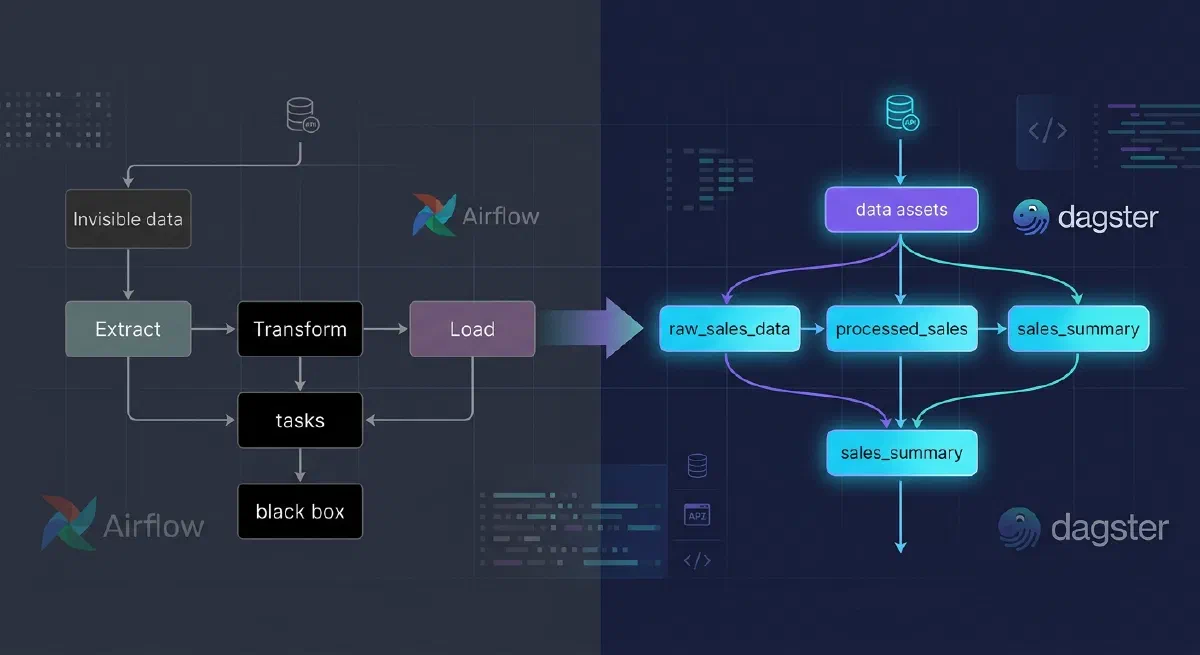
If you work in data engineering, you’ve probably grown tired of thinking about pipelines as a sequence of tasks: Extract → Transform → Load. But what if I told you that’s not the best way to model your data? Dagster revolutionized how we think about data orchestration with a simple yet powerful concept: Software-Defined Assets.
The Problem with Traditional ETL
In the traditional ETL model, we think in terms of processes:
 1
 2
 3
 4
 5
 6
 7
 8
 9
10
11
12
13
14
15
16
17
18
19
20
21
|
# Traditional approach - focused on TASKS
def extract_data():
    """Extracts data from the API"""
    data = requests.get('https://api.example.com/sales')
    return data.json()

def transform_data(raw_data):
    """Transforms the data"""
    df = pd.DataFrame(raw_data)
    df['total'] = df['quantity'] * df['price']
    return df

def load_data(df):
    """Loads into the database"""
    df.to_sql('sales', engine, if_exists='replace')

# Pipeline focused on EXECUTING tasks
def etl_pipeline():
    raw = extract_data()
    transformed = transform_data(raw)
    load_data(transformed)
|
What’s wrong with this?
- You don’t know WHERE your data is — only that you executed tasks
- No clear lineage — hard to trace where each piece of data comes from
- Re-runs are complicated — you need to run everything again
- Tests are hard — you test processes, not data
- Lack of visibility — you see that a task ran, but don’t know the state of the data
The Revolution: Thinking in Assets, Not Tasks
Dagster proposes a fundamental shift: think about WHAT you want (the data) and not HOW to do it (the tasks).
 1
 2
 3
 4
 5
 6
 7
 8
 9
10
11
12
13
14
15
16
17
18
19
20
21
22
23
24
25
26
27
28
|
import dagster as dg
import pandas as pd
import requests

@dg.asset
def raw_sales_data() -> pd.DataFrame:
    """Raw sales data from the API"""
    response = requests.get('https://api.example.com/sales')
    return pd.DataFrame(response.json())

@dg.asset
def processed_sales(raw_sales_data: pd.DataFrame) -> pd.DataFrame:
    """Processed sales with total calculation"""
    df = raw_sales_data.copy()
    df['total'] = df['quantity'] * df['price']
    df['processed_at'] = pd.Timestamp.now()
    return df

@dg.asset
def sales_summary(processed_sales: pd.DataFrame) -> pd.DataFrame:
    """Daily sales summary"""
    return processed_sales.groupby(
        pd.Grouper(key='date', freq='D')
    ).agg({
        'total': 'sum',
        'quantity': 'sum',
        'order_id': 'count'
    }).reset_index()
|
See the difference! Now:
- ✅ Each function defines ONE DATA (asset)
- ✅ Dependencies are explicit (through parameters)
- ✅ Dagster builds the graph automatically
- ✅ You can materialize assets individually
- ✅ Lineage is clear and traceable
How It Works in Practice
1. Defining a Simple Asset
 1
 2
 3
 4
 5
 6
 7
 8
 9
10
11
12
13
14
15
16
17
|
import dagster as dg

@dg.asset
def customers_data(context: dg.AssetExecutionContext):
    """List of active customers"""
    context.log.info("Loading customer data...")

    customers = [
        {"id": 1, "name": "John Silva", "status": "active"},
        {"id": 2, "name": "Mary Santos", "status": "active"},
        {"id": 3, "name": "Peter Costa", "status": "inactive"},
    ]

    active_customers = [c for c in customers if c['status'] == 'active']
    context.log.info(f"Found {len(active_customers)} active customers")

    return active_customers
|
2. Creating Dependencies Between Assets
 1
 2
 3
 4
 5
 6
 7
 8
 9
10
11
12
13
14
15
16
17
18
19
20
21
22
23
24
25
26
27
28
29
30
31
|
import dagster as dg
import pandas as pd

@dg.asset
def orders_raw() -> pd.DataFrame:
    """Raw orders from the database"""
    return pd.DataFrame({
        'order_id': [1, 2, 3, 4],
        'customer_id': [1, 1, 2, 3],
        'amount': [100.0, 150.0, 200.0, 75.0],
        'date': pd.date_range('2026-04-01', periods=4)
    })

@dg.asset
def customers() -> pd.DataFrame:
    """Customer data"""
    return pd.DataFrame({
        'customer_id': [1, 2, 3],
        'name': ['John Silva', 'Mary Santos', 'Peter Costa'],
        'segment': ['Premium', 'Standard', 'Premium']
    })

@dg.asset
def enriched_orders(orders_raw: pd.DataFrame, customers: pd.DataFrame) -> pd.DataFrame:
    """Orders enriched with customer data"""
    return orders_raw.merge(customers, on='customer_id', how='left')

@dg.asset
def revenue_by_segment(enriched_orders: pd.DataFrame) -> pd.DataFrame:
    """Total revenue by customer segment"""
    return enriched_orders.groupby('segment')['amount'].sum().reset_index()
|
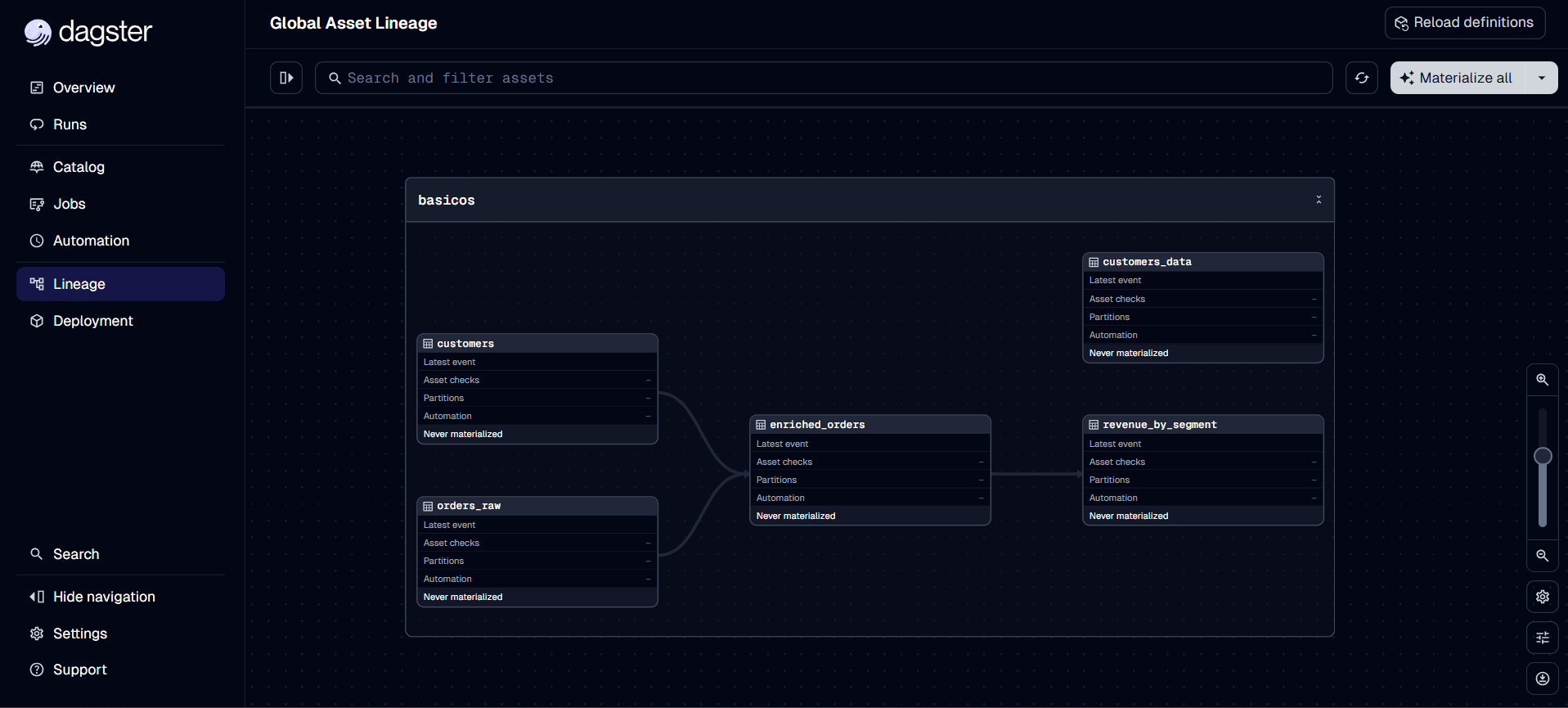
Dagster automatically understands that:
enriched_orders depends on orders_raw AND customersrevenue_by_segment depends on enriched_orders- If you update
customers, enriched_orders and revenue_by_segment become stale
3. Multi-Assets: Multiple Assets from a Single Operation
Sometimes you make ONE call that returns MULTIPLE pieces of data. Use @multi_asset:
 1
 2
 3
 4
 5
 6
 7
 8
 9
10
11
12
13
14
15
16
17
18
19
20
21
22
|
import dagster as dg

@dg.multi_asset(
    specs=[
        dg.AssetSpec("users"),
        dg.AssetSpec("posts"),
        dg.AssetSpec("comments")
    ]
)
def extract_from_api(context: dg.AssetExecutionContext):
    """Fetches data from multiple entities in a single API call"""
    context.log.info("Making single call to API...")

    api_response = {
        'users': [{'id': 1, 'name': 'John'}],
        'posts': [{'id': 1, 'user_id': 1, 'title': 'Hello'}],
        'comments': [{'id': 1, 'post_id': 1, 'text': 'Nice!'}]
    }

    yield dg.MaterializeResult(asset_key="users", metadata={"count": len(api_response['users'])})
    yield dg.MaterializeResult(asset_key="posts", metadata={"count": len(api_response['posts'])})
    yield dg.MaterializeResult(asset_key="comments", metadata={"count": len(api_response['comments'])})
|
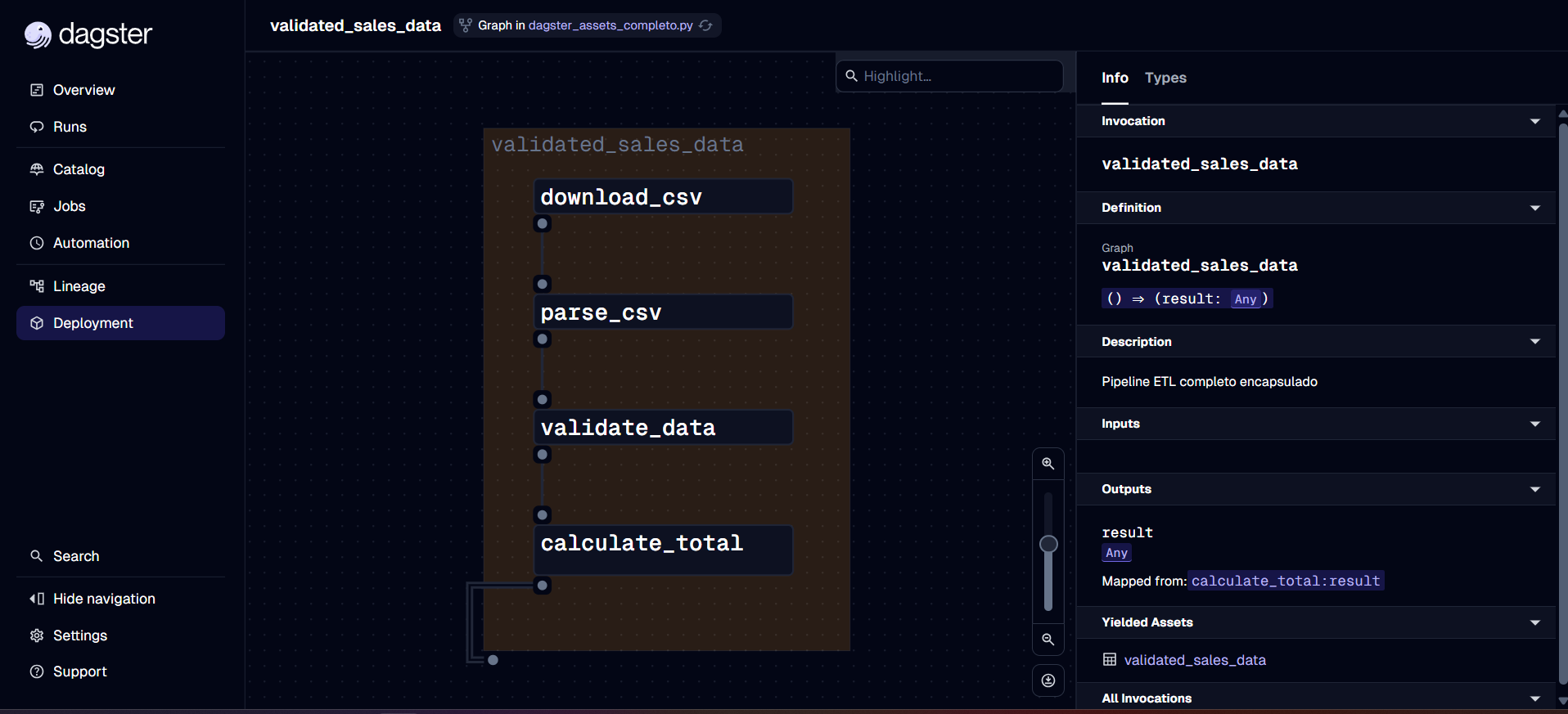
4. Graph Assets: Multiple Operations for One Asset
When you need several intermediate steps but only want to expose the final result (see more at Graph-backed assets):
 1
 2
 3
 4
 5
 6
 7
 8
 9
10
11
12
13
14
15
16
17
18
19
20
21
22
23
|
import dagster as dg

@dg.op
def download_csv(context: dg.OpExecutionContext) -> str:
    context.log.info("Downloading file...")
    return "s3://bucket/data.csv"

@dg.op
def parse_csv(context: dg.OpExecutionContext, file_path: str) -> list:
    context.log.info(f"Parsing {file_path}")
    return [{"col1": "val1"}, {"col1": "val2"}]

@dg.op
def validate_data(context: dg.OpExecutionContext, data: list) -> list:
    context.log.info(f"Validating {len(data)} records")
    return data

@dg.graph_asset
def validated_sales_data():
    """Final asset that encapsulates the entire process"""
    file = download_csv()
    parsed = parse_csv(file)
    return validate_data(parsed)
|
Defining Modern Jobs with Assets
 1
 2
 3
 4
 5
 6
 7
 8
 9
10
11
12
13
14
15
16
17
18
19
20
21
22
23
|
import dagster as dg

@dg.asset
def bronze_sales():
    return {"status": "raw"}

@dg.asset
def silver_sales(bronze_sales):
    return {"status": "cleaned"}

@dg.asset
def gold_sales(silver_sales):
    return {"status": "aggregated"}

all_assets_job = dg.define_asset_job(
    name="materialize_all_sales",
    selection=dg.AssetSelection.all()
)

defs = dg.Definitions(
    assets=[bronze_sales, silver_sales, gold_sales],
    jobs=[all_assets_job]
)
|
Real Example: E-commerce Pipeline
 1
 2
 3
 4
 5
 6
 7
 8
 9
10
11
12
13
14
15
16
17
18
19
20
21
22
23
24
25
26
27
28
29
30
31
32
33
34
35
36
|
import dagster as dg
import pandas as pd

@dg.asset(group_name="bronze")
def bronze_orders(context: dg.AssetExecutionContext) -> pd.DataFrame:
    """Raw orders from the e-commerce API"""
    orders = pd.DataFrame({
        'order_id': range(1, 101),
        'customer_id': [i % 20 for i in range(1, 101)],
        'product_id': [i % 10 for i in range(1, 101)],
        'quantity': [1, 2, 1, 3] * 25,
        'price': [99.90, 149.90, 199.90, 299.90] * 25,
        'created_at': pd.date_range('2026-03-01', periods=100, freq='h')
    })
    context.add_output_metadata({"num_orders": len(orders)})
    return orders

@dg.asset(group_name="silver")
def silver_orders_enriched(
    bronze_orders: pd.DataFrame,
    bronze_products: pd.DataFrame,
    bronze_customers: pd.DataFrame
) -> pd.DataFrame:
    """Orders enriched with product and customer data"""
    enriched = bronze_orders.copy()
    enriched['total'] = enriched['quantity'] * enriched['price']
    enriched = enriched.merge(bronze_products[['product_id', 'name', 'category']], on='product_id', how='left')
    enriched = enriched.merge(bronze_customers[['customer_id', 'city', 'segment']], on='customer_id', how='left')
    return enriched

@dg.asset(group_name="gold")
def gold_daily_revenue(silver_orders_enriched: pd.DataFrame) -> pd.DataFrame:
    """Aggregated daily revenue"""
    return silver_orders_enriched.groupby(
        silver_orders_enriched['created_at'].dt.date
    ).agg({'total': 'sum', 'order_id': 'count'}).reset_index()
|
Benefits of the Asset-First Approach
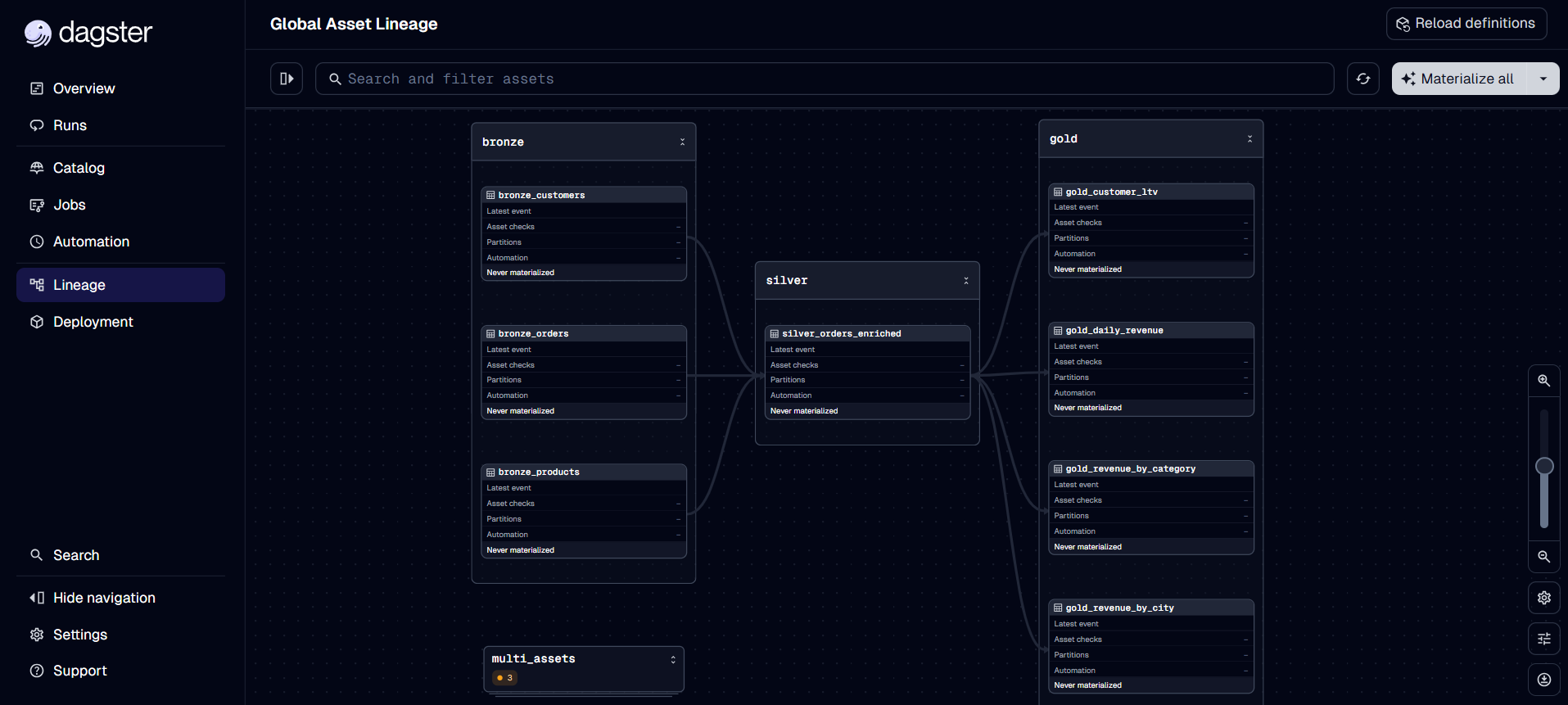
1. Automatic Lineage
Dagster automatically creates a dependency graph showing where each piece of data comes from.
2. Selective Materialization
Need to update just one asset? Just materialize it:
1
|
dg.materialize([gold_revenue_by_category])
|
1
2
3
4
5
6
7
8
9
|
@dg.asset
def sales_report(context: dg.AssetExecutionContext):
    df = compute_sales()
    context.add_output_metadata({
        "num_rows": len(df),
        "revenue_total": df['total'].sum(),
        "preview": dg.MetadataValue.md(df.head().to_markdown())
    })
    return df
|
4. Easier Testing
1
2
3
4
5
6
7
8
|
def test_revenue_calculation():
    fake_orders = pd.DataFrame({'quantity': [2, 3], 'price': [10.0, 20.0]})
    result = silver_orders_enriched(
        bronze_orders=fake_orders,
        bronze_products=pd.DataFrame(),
        bronze_customers=pd.DataFrame()
    )
    assert result['total'].tolist() == [20.0, 60.0]
|
Conclusion
The paradigm shift from traditional ETL to Software-Defined Assets is not just a syntax change — it’s a fundamental change in how to think about data:
- From: “I execute tasks that move data”
- To: “I define data and Dagster handles execution”
This brings:
- ✅ Greater clarity: you know exactly what data exists
- ✅ Better traceability: automatic lineage
- ✅ Flexibility: materialize only what you need
- ✅ Testability: pure functions are easy to test
- ✅ Observability: rich metadata and visual graph
If you’re still thinking about pipelines as sequences of tasks, it’s time to make the switch. The future of data engineering is asset-centric, not task-centric.
For a deeper dive, explore the official Dagster documentation and the GitHub repository.